INU Professor Seong-soo Shin Research Team Conducts Joint Study with Hongik University and KIST: Improves All-Solid-State Battery Performance and Long-Term Stability through 3D Interface Design, Published in the International Journal Small Structures
- 글번호
- 420769
- 작성일
- 2026-03-08
- 수정일
- 2026-03-08
- 작성자
- 홍보과 (032-835-9490)
- 조회수
- 213
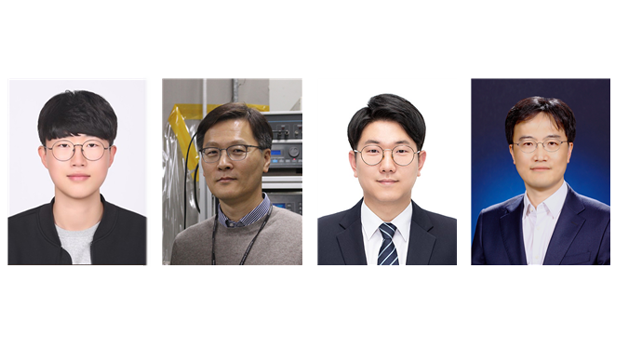
From left: Hye-seong Jeong (Ph.D. candidate, Korea Institute of Science and Technology; first author), Jong-ho Lee (Ph.D., KIST; corresponding author), Seong-soo Shin (Professor, Incheon National University; corresponding author), and Hyung-cheol Kim (Professor, Hongik University; corresponding author).
A research team led by Professor Seong-soo Shin of the Department of Mechanical Engineering at Incheon National University, in collaboration with Professor Hyung-cheol Kim of Hongik University and Dr. Jong-ho Lee of KIST, has developed an all-solid-state battery structure capable of stable long-term operation for over 600 cycles even under low pressure (0.86 MPa) by employing a three-dimensional interface structure design.
All-solid-state batteries are attracting attention as next-generation energy storage technologies because they eliminate the risk of fire and explosion. However, during charge and discharge cycles, volume changes in the electrodes weaken interfacial contact and significantly increase internal resistance. To address this issue, external pressures of tens of MPa or higher are typically required, which has been identified as a major barrier to commercialization.
The joint research team from Incheon National University, Hongik University, and KIST introduced free-standing membrane fabrication technology and ceramic micro-imprinting technology into sulfide-based solid electrolyte all-solid-state batteries. As a result, the system demonstrated stable operation for 1,000 hours in symmetric cells (where performance degradation in flat-interface structures began after approximately 400 hours). In full-cell tests, the battery achieved 12% higher initial capacity and more than twice lower interfacial resistance compared with flat-interface structures.
Additionally, through collaboration with the research team led by Professor Baek-jin Kim of the Department of Mechanical Engineering at Incheon National University, finite element analysis revealed that the 3D interface structure disperses uniaxial stress into planar directions, suppressing interface degradation and enabling stable operation even under low-pressure conditions of 0.86 MPa.
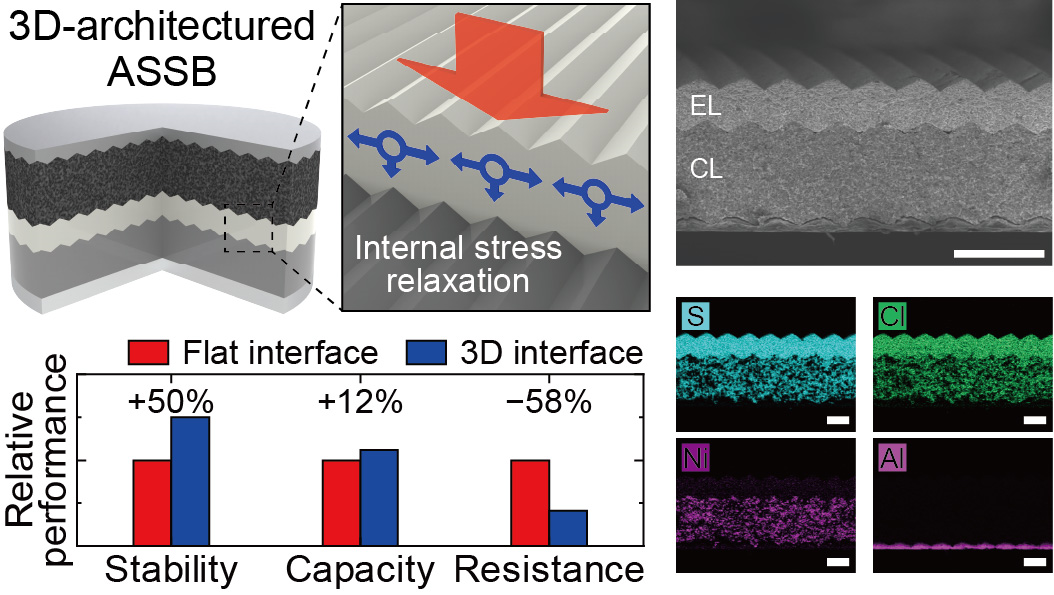
Comparison of microstructures, performance, and stability between all-solid-state batteries with a 3D interface structure and those with a conventional flat interface
Professor Seong-soo Shin of Incheon National University stated, “The strong dependence on high operating pressure has been one of the key challenges hindering the commercialization of all-solid-state batteries. This study is significant because it simultaneously improved both performance and lifespan solely through interface structure design without altering the materials.”
Dr. Jong-ho Lee of KIST commented, “This research presents a practical solution within sulfide-based electrolyte systems and significantly enhances the industrial scalability of all-solid-state batteries.”
Professor Hyung-cheol Kim of Hongik University added, “The three-dimensional interface is not merely a way to increase reaction area but a mechanical design strategy that controls internal stress transfer. The key contribution of this study lies in quantitatively identifying the structural, electrochemical, and mechanical correlations within all-solid-state batteries.”
This study demonstrates that performance and stability can be simultaneously improved solely through interface structure design without modifying the composition of electrodes or electrolytes, providing an important structural design strategy for the commercialization of next-generation all-solid-state batteries.
The research was published in the January 2026 issue of the internationally renowned journal Small Structures (Impact Factor: 11.3) under the title:
“Enhancing Cycling Stability of All-Solid-State Batteries with 3D-Architectured Interfaces via Controlled Yield Stress and Internal Stress Relaxation.”