Incheon National University–KIST Research Team Develops High-Performance Reversible Molten Carbonate Cell Using Intelligent Symmetric Electrode Technology that Forms Two Catalysts on a Single Electrode
- 글번호
- 420762
- 작성일
- 2026-03-08
- 수정일
- 2026-03-08
- 작성자
- 홍보과 (032-835-9490)
- 조회수
- 212
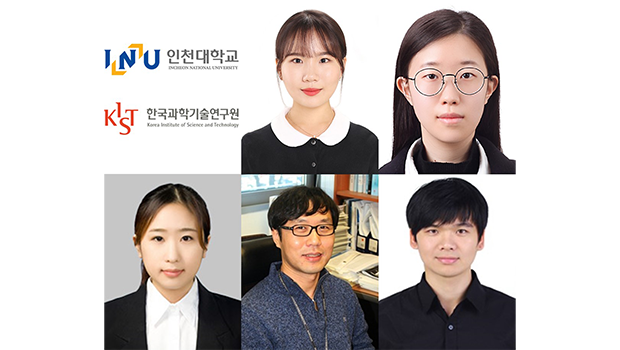
From top left) Boram Won, Ph.D. candidate in Materials Science and Engineering at Incheon National University (first author); Yeeun Kim, master’s student (second author); Gap-in Kim, researcher at the Hydrogen Fuel Cell Research Center of Korea Institute of Science and Technology (third author); Seong-pil Yoon, principal researcher at KIST (co-corresponding author); and Jaeha Myung, professor at Incheon National University (corresponding author).
A research team led by Professor Jaeha Myung of the Department of Materials Science and Engineering at Incheon National University and Dr. Seong-pil Yoon’s team at the Korea Institute of Science and Technology (KIST) has developed a “self-assembled symmetric electrode” technology, in which a single electrode material autonomously reconstructs into different catalysts depending on the operating environment. By applying this technology, the team successfully realized a high-performance reversible Molten Carbonate Cell (MCC). This achievement simultaneously overcomes the performance limitations of conventional commercial electrodes and the complexity of manufacturing processes, presenting a new turning point in the field.
Molten carbonate cells are next-generation electrochemical systems that operate at intermediate-to-high temperatures of around 650 °C. They can reversibly switch between power-generation mode, which produces electricity from chemical energy, and electrolysis mode, which generates fuel using electrical energy. The system offers high efficiency through combined operation utilizing high-temperature waste heat and can flexibly use various fuels such as natural gas and biogas.
In particular, molten carbonate cells are distinguished by their ability to simultaneously perform carbon capture and utilization. Exhaust gases from industrial processes or power plants can be injected into the air electrode to effectively capture carbon dioxide. In electrolysis mode, water and CO₂ can be converted simultaneously to produce hydrogen and syngas. This capability is attracting attention as a key technology for achieving a carbon-neutral energy system, enabling carbon not only to be reduced but also recycled as a high-value resource.
However, conventional nickel-based commercial electrodes have limitations in efficiency and durability due to slow air-electrode reaction kinetics and the dissolution of nickel into the electrolyte during long-term operation. Although oxide coatings have been explored to address these issues, difficulties in large-area manufacturing and reproducibility have limited commercialization.
To overcome these challenges, the research team introduced a simple “single-element dip-coating” process, in which commercial nickel electrodes are dipped into a lanthanum (La) coating solution and withdrawn. This approach significantly reduces manufacturing complexity while achieving uniform coating characteristics and high reproducibility even on large-area electrodes of 805 cm², demonstrating its feasibility for stack-level applications. In addition, by adopting a symmetric structure that uses the same electrode material for both the air electrode and the fuel electrode, the number of components was reduced and the cell assembly process was greatly simplified.
During heat treatment and operation for cell startup, the lanthanum-coated electrodes exhibited an “operando self-assembly” phenomenon, in which their structure spontaneously reconfigured depending on the electrode environment. As a result, LaNiO₃ catalysts formed in the air-electrode environment, while La₂O₃ catalysts with exsolved Ni nanoparticles formed in the fuel-electrode environment, effectively promoting the respective electrode reactions.
Through this technology, the team reduced electrode resistance by approximately 60% compared to conventional systems and achieved a high energy efficiency of 90.3% in electrolysis mode. The system also maintained stable voltage under harsh reversible operating conditions for over 200 hours, demonstrating excellent durability.
Notably, the technology improves performance and simplifies manufacturing processes without the use of precious metals, enhancing both economic feasibility and industrial scalability. As a result, it is expected to serve as a key enabling technology for accelerating carbon neutrality and building a sustainable future energy society.
This research was conducted through collaboration between the team of Professor Jaeha Myung at Incheon National University—led by Ph.D. candidate Boram Won (first author) and master’s student Yeeun Kim (second author)—and the KIST team led by Dr. Seong-pil Yoon, with Dr. Gap-in Kim as the third author. The study was supported by the Ministry of Trade, Industry and Energy and the Ministry of Science and ICT, through funding from the Korea Institute of Energy Technology Evaluation and Planning and the National Research Foundation of Korea. The findings were published online in February in the internationally renowned journal Applied Catalysis B: Environment and Energy (Impact Factor 21.1, JCR 0.99%).
- 첨부파일