Incheon National University Institute for Independence Movement Studies and Assembly Member Kim Kyo-heung Host Special Lecture on “Righteous Army Literature during the Japanese Invasion and the Spirit of Independence”
- 글번호
- 419452
- 작성일
- 2026-02-13
- 수정일
- 2026-02-13
- 작성자
- 홍보과 (032-835-9490)
- 조회수
- 646
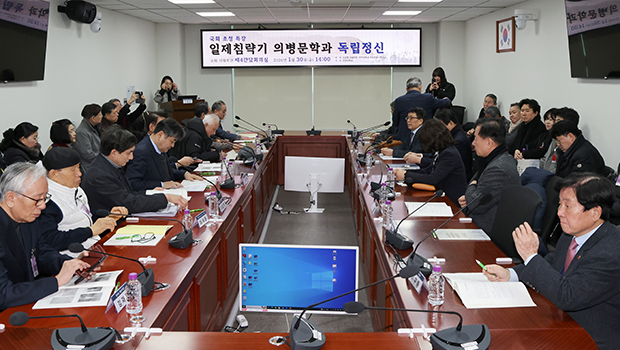
Special Lecture at the National Assembly Commemorating the Publication of Righteous Army Literature during the Japanese Invasion
- Co-hosted by the Incheon National University Institute for Independence Movement Studies and the Office of Assembly Member Kim Kyo-heung… Attended by descendants of independence patriots, veterans’ affairs officials, academia, and civil society
On January 30, 2026, a special invited lecture titled “Righteous Army Literature during the Japanese Invasion and the Spirit of Independence” was held at the National Assembly, co-hosted by the Office of Assembly Member Kim Kyo-heung and the Incheon National University Institute for Independence Movement Studies. The event was organized to share the historical significance and public value of righteous army literature and the spirit of independence through an academic lecture.
The event was attended by members of the National Assembly, the Minister of Patriots and Veterans Affairs, representatives of the Liberation Association, descendants of independence patriots, righteous army commanders and members of the Korean Heroic Corps, as well as figures from academia, civil society, and the media.
The program began with opening remarks by Assembly Member Kim Kyo-heung, a co-host of the event. He explained that righteous army literature played a vital role in spreading the people’s will to resist and in legitimizing the restoration of national sovereignty, emphasizing that this spirit later led to the March 1st Movement and the establishment of the Provisional Government of the Republic of Korea. He also cited independence activists representing Incheon, including Juksan Jo Bong-am and Mano Hong Jin, highlighting Incheon as a significant historical site of the anti-Japanese independence movement. He stated, “As a member of the National Assembly, I will faithfully carry out my responsibilities so that today’s discussion may serve as an opportunity for history and democratic values to continue in our daily lives.”
Assembly Member Kang Kyung-sook, in her congratulatory remarks, stressed the need to move beyond a perception of the independence movement centered solely on armed struggle and to pay attention to the history of intellectual resistance through literature, records, newspapers, and proclamations.
Kwon O-eul, Minister of Patriots and Veterans Affairs, noted in his lecture that the way a historical period is defined by terminology can influence public perception of history. He pointed out the difference in meaning between the terms “Enlightenment Period” and “Japanese Invasion Period,” stating that the records and literature left by ancestors should be experienced as living narratives by today’s citizens. He further affirmed that the Ministry would fulfill its role in connecting independence movements, national defense, and democratic movements within modern history to the present.
Choi Yong-gyu, former Chair of the Board of Trustees of Incheon National University, introduced the establishment and development of the Institute for Independence Movement Studies. Despite limited budgets and personnel, he explained that the institute has continuously worked to discover unrecognized independence activists and conduct historical research, while emphasizing the need for national-level financial and institutional support based on relevant legislation.
Lee In-jae, President of Incheon National University, remarked that righteous army literature represents a historical form of resistance not only through armed struggle but also through writing, language, records, and ideas. He stated that the Institute has continuously supported the discovery of unrecognized independence activists and their connection to national honors, and that major research outcomes—including documentation of 73 righteous army commanders during the Japanese invasion—have linked historical records to contemporary public values.
In his special lecture, Lee Tae-ryong, Director of the Incheon National University Institute for Independence Movement Studies, presented the outcomes of his research, which began in the 1980s with nationwide efforts to uncover righteous army documents and materials. He explained that he had discovered more than 700 works, of which 324 with literary and historical value were systematically compiled. Drawing on overseas archival materials and domestic historical documents, he addressed the activities of the righteous armies, cases of Japanese military repression, and issues related to certain historical narratives and terminology. He emphasized the need to revise and supplement historical terminology and descriptions in textbooks and public record systems.
Descendants of independence patriots and representatives from veterans’ and civil society organizations who attended the event shared a common understanding of the significance of righteous army literature and the spirit of independence. The event concluded with a consensus on the need to expand this historical legacy into public domains such as legislation, veterans’ policies, and educational curricula.